
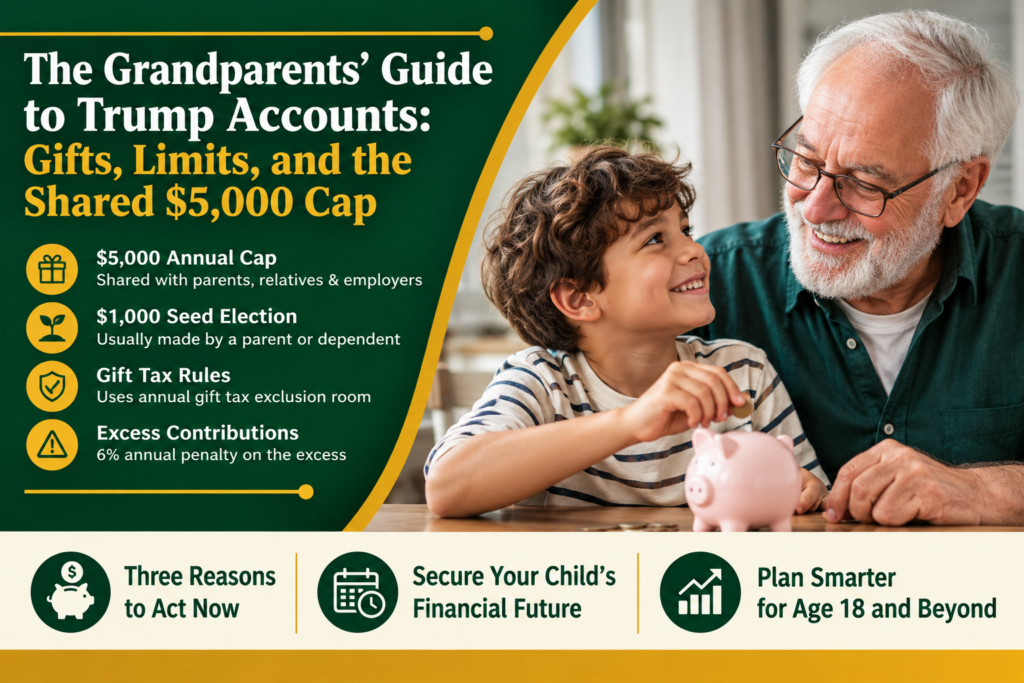
Yes, grandparents can contribute to a grandchild’s Trump Account, up to the account’s $5,000 annual limit. But that limit is shared with everyone else who gives, including the parents and any employer, so coordination matters more than generosity. And under 2026 IRS guidance, a contribution within the annual gift tax exclusion doesn’t require a gift tax return.
Here’s the complete picture for grandparents who want to help.
Key Takeaways:
• Grandparents can contribute once the account is open, but the $5,000 annual cap is shared with parents, relatives, and employers.
• The $1,000 seed election generally must be made by someone who can claim the child as a dependent, usually a parent.
• A contribution is a gift and uses annual gift tax exclusion room ($19,000 per recipient for 2026). The Rev. Proc. 2026-25 safe harbor means no gift tax return when total gifts to the child fit inside the exclusion.
• Exceeding the cap triggers a 6% annual penalty on the excess until it’s removed.
• Education gifts still belong in the 529. The Trump Account is a retirement head start for a grandchild.
Can a grandparent open the account, or just contribute to it?
It depends on the seed. If the family is claiming the $1,000 federal seed, the election generally must be made by someone who can claim the child as a dependent for the child tax credit, which usually means a parent. If the seed isn’t in play, an authorized individual, including a grandparent, parent, legal guardian, or adult sibling, can open the account for a child under 18 with a work-eligible Social Security number.
The practical move for most grandparents: confirm with your adult child that the account exists (or nudge them to open it and claim the seed), then contribute directly to the account rather than handing over cash and hoping it lands. How to Open a Trump Account.
How much can a grandparent contribute?
Up to $5,000 per grandchild per year, minus whatever everyone else has already contributed. The cap is per child, not per giver. Parents, grandparents, aunts, family friends, and an employer all draw from the same $5,000 pool, and the limit is indexed for inflation after 2027.
This is the single most common mistake in the making. Picture it: the parents set up a $2,500 employer contribution through work, then a grandparent independently deposits $5,000 as a birthday gift. The account is now $2,500 over the limit, and the IRS charges a 6% penalty on the excess every year until it’s pulled back out. The fix costs a phone call: agree as a family on who funds what, and appoint 1 person to track the running total each year.
The $1,000 federal seed and qualifying charity or government deposits sit outside the cap, so they don’t eat into your $5,000 of room. What Is a Trump Account?
Do grandparent contributions trigger gift tax paperwork?
Generally no. Revenue Procedure 2026-25, issued June 29, 2026, created a safe harbor: qualifying cash contributions are treated as present-interest gifts covered by the annual gift tax exclusion, which is $19,000 per recipient for 2026, with no gift tax return required. Note the logic carefully: the contribution counts as a gift and uses up part of your annual exclusion for that grandchild. It doesn’t sit outside the gift rules. And the safe harbor has
conditions: it applies only if your total gifts to that grandchild for the year, including the Trump Account contribution, stay within the annual exclusion, and only if you aren’t otherwise required to file a gift tax return that year for any reason.
Where it gets interesting is when a Trump Account contribution lands in the same year as a large 529 gift, especially a superfunded 529 that front-loads 5 years of exclusions. Stack a $5,000 Trump Account contribution on top of a maxed 5-year 529 election for the same grandchild, and you can exceed the exclusion, which knocks the contribution out of the safe harbor and puts you in return-filing territory. Nothing catastrophic happens (the excess
typically just reduces your lifetime exemption), but grandparents making both kinds of gifts should have their CPA run the totals per grandchild, per year. Trump Account vs. 529 Plan.
Is the Trump Account the best gift, or should you keep funding the 529?
It depends on what the money is for. Education money still belongs in the 529, where growth used for school is never taxed. The Trump Account’s growth is taxed as ordinary income eventually, which makes it the wrong primary vehicle for tuition. What the Trump Account does that nothing else can: it works from birth with no earned income
requirement, it captures the free $1,000 seed for eligible grandchildren, and it plants a retirement seed 4 or 5 decades before your grandchild would otherwise start.
A sensible split many grandparents land on: make sure the seed is claimed, direct education gifting to the 529, and use the Trump Account for a deliberate, modest, long-horizon gift, the kind that’s about your grandchild’s age 65, not their age 18. For choosing among all the options at each stage of a grandchild’s life: [[LINK → TA-7: The Best Account for Your Child at Every Age]]
What should grandparents watch out for?
3 things. Control: at 18 the account is legally your grandchild’s traditional IRA, with no strings available. If control matters to you, compare the alternatives first. [[LINK → TA-6: Trump Account vs. UTMA/UGMA]] Basis records: your after-tax contributions create basis that comes out tax free decades from now, but only if someone keeps the records. Send your adult child a simple confirmation of each year’s contribution for the file. And the shared cap, one more time, because it’s the trap with an actual penalty attached: coordinate before you contribute.
Common Mistakes:
1. Contributing $5,000 without asking what the parents and their employer already put in this year.
2. Stacking a Trump Account gift on a superfunded 529 in the same year without running the exclusion totals.
3. Handing cash to the parents instead of contributing directly and documenting it.
4. Expecting control past 18. The account becomes the grandchild’s IRA, with no strings available.
5. Skipping the basis paper trail that makes your contributions tax free decades from now.
Ready to take action?
Speak to the team: → https://creativefinancialgrp.com/cfg-start-here/
Frequently Asked Questions
Can grandparents contribute to a grandchild’s Trump Account?
Yes. Anyone can contribute once the account is open, subject to the shared $5,000 annual limit across all
contributors combined.
Can a grandparent claim the $1,000 federal seed?
Generally no. The seed election must usually be made by someone who can claim the child as a dependent for the child tax credit, which is typically a parent.
Do Trump Account contributions count against the gift tax exclusion?
Yes. A contribution is a gift to the grandchild and uses annual exclusion room, which is $19,000 per recipient for 2026. Under the Rev. Proc. 2026-25 safe harbor, contributions fitting within the exclusion don’t require a gift tax return.
What happens if the family contributes more than $5,000 in a year?
The excess is penalized at 6% per year until removed. The cap is shared, so families should designate 1 person to track total contributions per child per year.
Is a Trump Account or a 529 the better grandparent gift?
For education, the 529, because qualified growth is tax free. For a retirement head start that works from birth, the Trump Account. Many grandparents fund both with different jobs in mind.
About the Author
Kurt Supe is a CPA and Senior Partner at Creative Financial Group, an Indianapolis-based retirement planning firm. CFG has worked with retirees and pre-retirees for nearly 30 years, managing over 600M dollars in assets across 1,500 households. Kurt contributes to MarketWatch on retirement and tax planning topics.
This is not financial advice. Consult a qualified professional before making any financial decisions. Scenarios are hypothetical and for illustrative purposes only.