
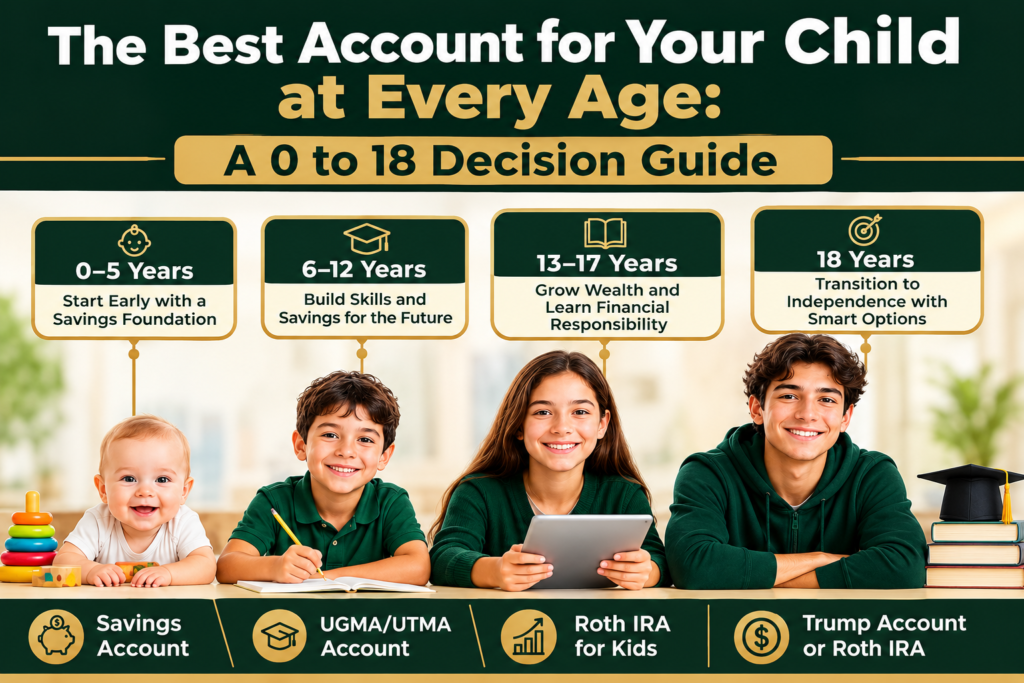
There’s no single best account for a child. There’s a best account for each job at each age: the Trump Account for free money and retirement from birth, the 529 for education, the custodial Roth IRA once a teenager has earned income, and the UTMA for flexible spending money. This guide walks the whole timeline, birth to 18. The order below assumes the parents’ own retirement and emergency savings are on track first. A child’s greatest financial asset is parents who won’t need their support later.
Key Takeaways:
• There’s no single best account, only the best account for each job: free money and retirement, education, earned-income Roth, and flexible UTMA.
• At birth: claim the $1,000 seed if the child qualifies, then open the 529.
• Ages 1 to 12: fund by goal. Education to the 529, the long-horizon retirement gift to the Trump Account, flexible money to a UTMA.
• The first real earned income unlocks the custodial Roth IRA, usually the best destination for new dollars from then on.
• Ages 16 to 18: mind the Trump Account enrollment deadline, FAFSA positioning, and the age 18 conversion conversation.
Birth to age 1: claim the free money, open the education lane
First move, if your child was born January 1, 2025 through December 31, 2028: open the Trump Account and elect the $1,000 federal seed. It isn’t automatic, and every year of delay is a year of lost compounding on free money. [[LINK → TA-8: How to Open a Trump Account]] Check whether your employer contributes to Trump Accounts, since up to $2,500 per year of employer money is a benefit you either capture or forfeit, and check TrumpAccounts.gov for charity and state programs your child qualifies for.
Second move: open the 529, because education is usually the biggest known expense on the horizon and the 529’s tax-free growth needs years to work. Grandparents who want in should read the coordination rules before writing checks, since the Trump Account’s $5,000 cap is shared across all givers. The Grandparents’ Guide to Trump
Accounts
Ages 1 to 12: fund by goal, not by hype
These are the quiet compounding years, and the mix is a goals question. Education dollars go to the 529 first, where growth used for school is never taxed. Trump Account vs. 529 Plan. Retirement-for-your-kid dollars, the truly long-horizon gift, go to the Trump Account, the only account that builds retirement money with no earned income requirement. Flexible dollars, the ones you might spend on braces, a first car, or a teenage opportunity you can’t name yet, go to a UTMA, with eyes open about the annual kiddie tax drag. Trump Account vs. UTMA/UGMA
A useful gut check for each contribution: when do I want my child to touch this dollar? At college age, 529. Whenever needed, UTMA. At retirement, Trump Account.
Ages 13 to 15: watch for the first earned income
The moment your child earns legitimate income, W-2 wages, or real self-employment income with records to prove it, a new account outranks everything: the custodial Roth IRA. Roth dollars go in after tax and come out tax free in retirement, contributions can be withdrawn anytime without penalty, and a teenager’s tax rate is usually 0%, which makes it the cheapest Roth funding they will ever do.
The contribution is capped at the lesser of the child’s earned income or the annual IRA limit, but the cash can come from anyone. A parent or grandparent matching the teen’s summer earnings into the Roth is one of the highest-leverage habits in family finance. Trump Account vs. Roth IRA for Kids
Ages 16 to 18: sequence the endgame
3 items belong on the checklist now. First, the Trump Account enrollment deadline: an account must be opened while the child is still under 18 at year-end, so this is the last window for families who never opened one. Second, financial aid positioning: if college aid is in play, know that UTMA balances count against your student, 529s barely do, and the Trump Account’s treatment is genuinely unsettled, so avoid childhood-account withdrawals in FAFSA-counted years. Do Trump Accounts Hurt Financial Aid? . Third, start the conversion conversation: at 18 the Trump Account becomes your child’s traditional IRA, and their first independent low-income years are the cheap window to convert it to a Roth. That decision lands better when it’s been discussed since 16.
The one-paragraph version
Claim the Trump Account seed at birth and capture any employer money. Build education savings in the 529 through childhood. Keep flexible money in a UTMA if you need it, taxes noted. Pivot new dollars to a custodial Roth the year real earned income shows up. And teach your future 18-year-old what they’re holding, because at that point every one of these accounts starts becoming theirs.Common Mistakes:
1. Funding children’s accounts before the parents’ retirement and emergency savings are on track.2. Missing the free seed and employer contributions while optimizing everything else.
3. Using 1 account for every goal and paying the wrong tax treatment on most of it.
4. Missing the custodial Roth window when a teenager starts earning.
5. Reaching 18 without ever teaching the child what they own.
Ready to take action?
Speak to the team: → https://creativefinancialgrp.com/cfg-start-here/
Frequently Asked Questions
What’s the best account to open for a newborn?
Start with a Trump Account if the child qualifies for the $1,000 federal seed, because it’s free money. Then open a 529 for education savings, which is usually the largest known future expense.
When should a child get a Roth IRA?
As soon as they have real earned income, from a W-2 job or documented self-employment. Contributions are limited to the lesser of their earnings or the annual IRA limit.
Can a child have a Trump Account, a 529, a UTMA, and a Roth IRA at once?
Yes. The accounts have separate rules and separate jobs, and many well-planned families eventually use all 4.
What’s the deadline to open a Trump Account?
The account must be opened by the end
of the year in which the child is 17. The $1,000 seed additionally requires birth between January 1, 2025 and December 31, 2028.
Should I save for my kids before my own retirement?
Generally no. Your children can
borrow for education, but nobody lends for retirement. Most planners, ourselves included, put the parents’ retirement and emergency fund ahead of children’s accounts.
About the Author
Kurt Supe is a CPA and Senior Partner at Creative Financial Group, an Indianapolis-based retirement planning firm. CFG has worked with retirees and pre-retirees for nearly 30 years, managing over 600M dollars in assets across 1,500 households. Kurt contributes to MarketWatch on retirement and tax planning topics.
This is not financial advice. Consult a qualified professional before making any financial decisions. Scenarios are hypothetical and for illustrative purposes only.