
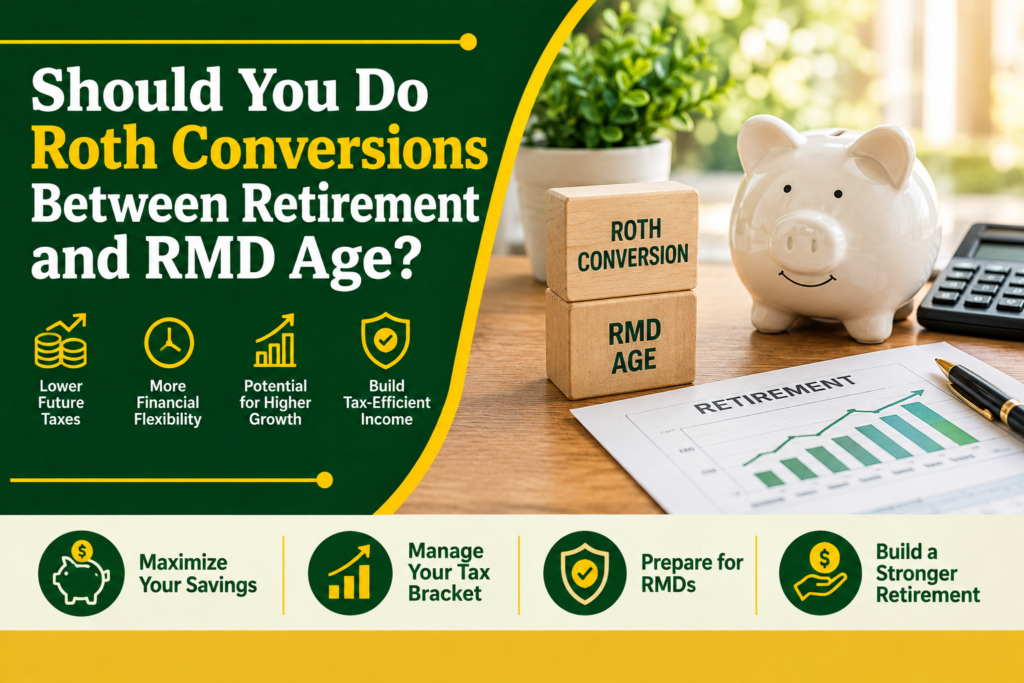
Quick Answer:
For most retirees, yes. The years between retiring and age 73 are usually the best time to convert to Roth, because your income is at its lowest. With no paycheck and no required withdrawals yet, you often drop into a low bracket, which lets you move money to tax-free status cheaply and shrink the large required withdrawals coming later.
Key takeaways:
– The “gap years” run from your retirement date to age 73, when required withdrawals begin.
– In these years your income is often at its lifetime low, opening room to convert at 10% or 12%.
– Converting now shrinks the traditional balance that would otherwise drive large, highly taxed RMDs later.
– The window is limited and closes for good once RMDs start, so the gap years are use-it-or-lose-it.
There’s a window in early retirement when the tax planning stars line up, and most people don’t even know it exists. It opens the day you stop working and closes when required withdrawals begin. If you have a large traditional IRA, what you do in these years can save you a great deal of tax for the rest of your life. Here’s why they matter.
What are the gap years?
The gap years are the stretch between the day you retire and the day required minimum distributions begin at age 73. During this window you’ve stopped earning a paycheck, but the IRS isn’t yet forcing withdrawals from your traditional accounts, so you often have unusually low taxable income. For many people it’s the lowest-income period of their adult lives.
That low income is the opportunity. Under the IRS required minimum distribution rules, RMDs don’t start until 73, which can leave several years of open space. If you also delay claiming Social Security, that space gets even wider. Those low-income years are a chance to do things that are expensive at any other time.
Why are the gap years the best time to convert to Roth?
The gap years are the best conversion window because you can move money into a Roth at rates you may never see again. With little other income, per the IRS a married couple can fill the 10% and 12% brackets, converting up to $100,800 of taxable income before reaching the 22% bracket in 2026. Converting at those low rates is the whole game.
There are 2 benefits at once. You pay tax on the conversion now, while your bracket is low, and you shrink the traditional balance that would otherwise produce large RMDs taxed at higher rates later. Skip this window, and you often end up converting on top of forced withdrawals in your 70s and 80s, at much higher rates. For the full timing framework, see when should you do a roth conversion, and for sizing, see how much should you convert to roth each year.
How do gap-year conversions lower your future RMDs?
Gap-year conversions lower future RMDs by shrinking the account those RMDs are calculated from. Your required withdrawal each year is your traditional balance divided by a life-expectancy factor, so a smaller balance means a smaller forced withdrawal. Every dollar you convert out of the traditional IRA during the gap years is a dollar that won’t be there generating a taxable RMD later.
This matters because unmanaged RMDs can push you into a higher bracket in your 70s than you were in your 60s, and drag your Social Security into taxation while raising your Medicare premium. Converting during the gap years is one of the most effective ways to defuse that future pile-up. It’s a core strategy in how to reduce RMDs before age 73, and the mechanics of how RMDs are figured are in when do RMDs start and how are they calculated.
When do the gap years not make sense for conversions?
The gap years don’t favor conversions when your income during them isn’t actually low, or when your future rate will be lower than today’s. If you’re retiring with a large pension that already fills your brackets, or you plan to make a big charitable bequest that will absorb the traditional balance tax-efficiently anyway, aggressive conversions may not pay off. The strategy depends on the gap between your rate now and your expected rate later.
There’s also a cash-flow consideration. Conversions work best when you can pay the tax from a taxable account rather than the IRA itself. If you’d have to use IRA money to cover the tax, the benefit shrinks. As with any conversion, the answer is specific to your balances, your income, and your goals, which is why a multi-year map beats a rule of thumb.
What else should you do during the gap years?
Roth conversions are the headline move, but the gap years are prime time for a few other strategies, and they interact. Harvesting capital gains at the 0% rate is one, though it competes with conversions for the same low-bracket space, so you usually lean into one or the other in a given year. Delaying Social Security is another, since it keeps your income low now and raises your benefit later, widening the very window that makes conversions cheap.
There’s also a healthcare angle for those who retire before 65. If you buy coverage through the insurance marketplace, keeping your income low can qualify you for premium subsidies, which pulls in the opposite direction from a big conversion. That tension is real, and it’s why the gap-year plan has to look at the whole picture, not just the conversion in isolation. The right mix depends on your age, your health coverage, and how much traditional balance you’re trying to move.
Frequently Asked Questions
How long do the gap years usually last?
It varies, but for someone who retires in their early to mid 60s, the gap to age 73 can be 8 to 12 years. Delaying Social Security can extend the low-income window even further within that period.
Do I have to stop converting once RMDs begin?
No, but it gets harder. Once RMDs start, you must take the required withdrawal first, and it counts as income. Any conversion then stacks on top of that, usually at a higher rate, which is why the gap years are so valuable.
Should I delay Social Security to widen the conversion window?
Often yes. Delaying Social Security keeps your income low during the gap years, creating more room to convert at low rates, and it also raises your eventual benefit. The 2 strategies reinforce each other.
Can I convert every year during the gap?
Yes, and usually you should. Converting a measured amount each year, filling the same low bracket annually, moves far more money at low rates than one large conversion, which would spike your rate and trigger surcharges.
The gap years are a limited window, and the retirees who use them well often save years of future tax. If you’d like to map your conversions across the years before RMDs begin, request a meeting and we’ll build the plan.
About the Author
Kurt Supe, CPA, is a Retirement Planner and Chief Investment Officer for Creative Financial Group. He has spent 30 years helping retirees lower their lifetime tax bills. Connect on X and YouTube at @KurtSupeCPA, or read more on the CFG team page.